Menu
Menu


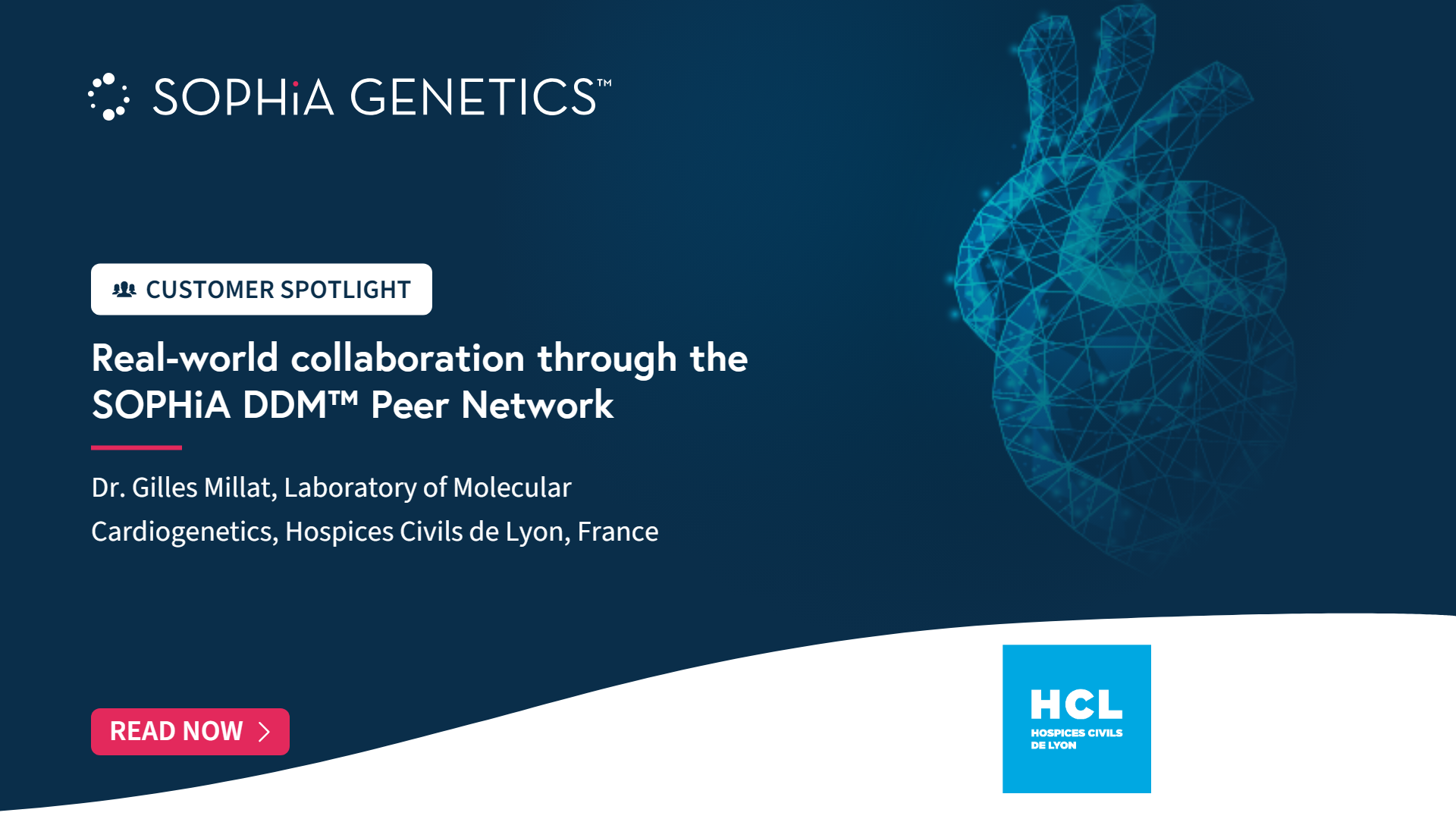
Dr. Gilles Millat, Laboratory of Molecular Cardiogenetics, Hospices Civils de Lyon, France.
For more than two decades, Dr. Millat has focused on the genetics of hereditary cardiac disorders at the University Hospital of Lyon. Originally trained in molecular biology, his work evolved from lysosomal storage disorders to inherited cardiac diseases, particularly cardiomyopathies and cardiac arrhythmias.
These disorders present important interpretive challenges:
Hypertrophic and dilated cardiomyopathies alone affect approximately 1 in 200-500 individuals. As demand for genetic testing grows, his laboratory expects to process ~5,000 cases in 2025, including 2,500 new probands, with volumes increasing 10–20% each year.
Dr. Millat’s laboratory has used SOPHiA DDM™ for more than a decade, now integrated as a central element in the analysis workflow. He highlights three key benefits:
“With just a few clicks, we can access everything needed to process a patient’s file from A to Z in only a few minutes.”
To date, nearly 15,000 patient cases have been analyzed, with approximately 700 variants per case, all systematically classified on a scale of 1-5.
In addition to the core platform, the SOPHiA DDM™ Peer Network enables some expert cardiogenetics labs across France to share variant interpretations. This collective expertise provides confirmation and confidence for complex cases.
Case example: Filamin C variant reclassification
A 70-year-old patient with hypertrophic cardiomyopathy presented with a rare FLNC variant. Although evidence supported pathogenicity, concerns about background noise led the Lyon team initially to classify it as a Variant of Uncertain Significance (VUS - Class 3).
Through the Cardio Peer Network, they found that colleagues in CHU Nantes had seen the same variant, also classified as a VUS, with a highly similar phenotype. Collaborative review allowed both teams to upgrade the classification to Class 4 (likely pathogenic).
This reclassification enabled relatives in both families to be offered presymptomatic testing, supporting earlier surveillance and informed management decisions.
“Without the Cardio Peer Network, we would have kept this variant as Class 3. Clearly, the Cardio Peer Network helped us.”
Together, SOPHiA DDM™ and the Cardio Peer Network have enabled scale, precision, and expertise sharing at CHU de Lyon, improving variant classification and informing care for patients and families affected by inherited cardiac pathologies.
Interested in SOPHiA DDM™ Peer Networks?
Connect with our team to learn how your laboratory can contribute to advancing variant classification in your field of expertise.
The opinions expressed during the video are those of the speaker and may not represent the opinions of SOPHiA GENETICS.
Any use of SOPHiA GENETICS products described in the video may not have been cleared or approved by Regulatory Authorities.
SOPHiA DDM™ Solutions are For Research Use Only unless otherwise specified.
SOPHiA GENETICS products are for Research Use Only and not for use in diagnostic procedures unless specified otherwise.
SOPHiA DDM™ Dx Hereditary Cancer Solution, SOPHiA DDM™ Dx RNAtarget Oncology Solution and SOPHiA DDM™ Dx Homologous Recombination Deficiency Solution are available as CE-IVD products for In Vitro Diagnostic Use in the European Economic Area (EEA), the United Kingdom and Switzerland. SOPHiA DDM™ Dx Myeloid Solution and SOPHiA DDM™ Dx Solid Tumor Solution are available as CE-IVD products for In Vitro Diagnostic Use in the EEA, the United Kingdom, Switzerland, and Israel. Information about products that may or may not be available in different countries and if applicable, may or may not have received approval or market clearance by a governmental regulatory body for different indications for use. Please contact us to obtain the appropriate product information for your country of residence.
All third-party trademarks listed by SOPHiA GENETICS remain the property of their respective owners. Unless specifically identified as such, SOPHiA GENETICS’ use of third-party trademarks does not indicate any relationship, sponsorship, or endorsement between SOPHiA GENETICS and the owners of these trademarks. Any references by SOPHiA GENETICS to third-party trademarks is to identify the corresponding third-party goods and/or services and shall be considered nominative fair use under the trademark law.